Futures plunge, bonds roiled, pharma next tariff target, Delta & Wal-Mart warn, oil upgrades
Boy do I miss live TV right about now.

In our latest episode of In the Money with Amber Kanwar, Jeannine LiChong of Waratah Capital advised against buying the dip and instead advocated for waiting for clarity in the markets. Her comments are proving prescient given the news in the last 24 hours. She isn’t buying much, but she gave three stocks she thinks can continue to hold up despite the market turmoil. Watch here!
This newsletter is sponsored by BMO InvestorLine. The newsletter and the podcast may give you some interesting investment ideas. To help you research and potentially act on those ideas, consider BMO InvestorLine. Their platform provides the resources you need to analyze potential investments, with the valuable tools and research you need when exploring the market. Plus, you’ll find the BMO Investment Learning Centre with educational courses and videos empowering you to make informed decisions. Learn how you can earn up to $3,500 cash back when you open a new account.
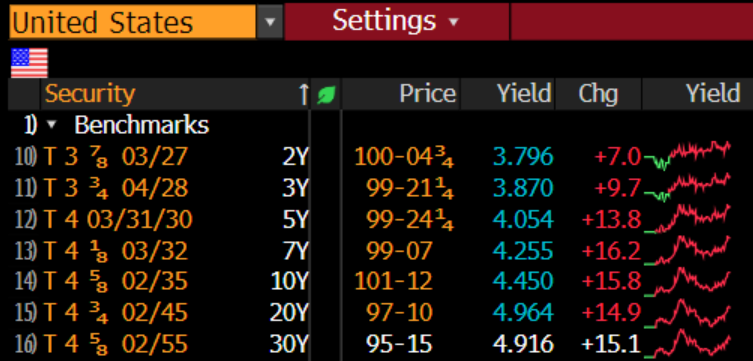
Nightmare on Wall Street: US futures are plunging once again as the bond market gets crushed and China hits back on tariffs. This morning China raised their tariff on US goods to 84% one day after the US jacked up their tariffs, marking a significant escalation in the tit-for-tat trade war. Amidst the trade war, China has been devaluing their currency in an effort to offset the impact of tariffs. Treasury Secretary Scott Bessent has taken notice of that this morning and is urging China not to devalue their currency as their way out of the trade war. Markets are bracing for the US reaction. Yesterday markets posted another stunning intra-day reversal (dropping 7% from peak to trough) after the US announced tariffs on Chinese goods would go up to 104%. And then there is the bond market. There is a blow out in yields right now (meaning bond prices are going lower and interest rates are going higher). When this happens in a short period of time this can create chaos for stocks and exert further downside pressure. One of the reasons the move is so quick is because of the unwind of the so-called basis trade. Thanks to my pal Frances Horodelski for unearthing a great explanation of what the basis trade is and why it is now a big problem. “In the basis trade, hedge funds put on leveraged bets, sometimes up to 100 times, with the goal of profiting from the convergence between the futures price and the bond price, as the futures contract approaches expiry,” wrote Torsten Sløk, Apollo’s chief economist. This is a huge part of the market, says Sløk, representing $800 billion of $2 trillion outstanding balances. When there is a spike in yields like we have seen recently, it can force these highly levered long positions to sell. As a result of the sharp sell-off in bonds, we could see emergency intervention by the Federal Reserve. “If recent disruption in the US Treasury market continues we see no other option for the Fed but to step in with emergency purchases of US Treasuries to stabilize the bond market,” wrote Deutsche Bank’s currency strategist George Saravelos in a note to clients. Meanwhile, Bessent doesn’t see any problems calling this “normal deleveraging in the bond market” and “nothing systemic.” Alrighty then.
The damage: Let’s take stock of some of the damage this trade war has caused financial assets:
S&P 500: Poised to open at a 14-month low, down nearly 20% from all-time high, every single sector is down in 2025. Worst four-day sell-off in stocks since 1987. The S&P 500 is on pace for one of its fastest-ever 20% declines from an all-time high
NASDAQ: Trading at a 15-month low, down 24% from all-time high. Approaching technical “death cross” where 50-day moving average crosses below 200-day moving average. The Magnificent 7 is trading at an 8-month low, down 30% from all-time high in December.
TSX: Trading at an 8-month low, down 13% from all-time high, gold is the only sector positive for 2025, since tariff announcement on April 2nd no sectors are positive.
Oil: Trading at a 4-year low at $56/bl, down 30% from 2025 peak as recession fears grow
Russell 2000: Trading a 1.5 year low, down nearly 30% from recent high
Financials: Canadian banks are trading at an 8-month low, TD is the only bank stock higher in 2025. In the US, the bank index is also at an 8-month low with no banks higher in 2025. Regional banks in the US are at the lowest level since July and down 30% from the peak in November.
The beatings will continue: Global pharma stocks are under pressure as US President Donald Trump warns a “major tariff on pharmaceuticals” is coming soon. Shares of AstraZeneca (-6.7%), Novo Nordisk (-3%), Roche (-6.5%) and Novartis (-4%) are all plunging overseas. However, even US pharma companies are trading lower. Shares of Pfizer have slumped to the lowest level since 1997. Merck (-4%) , Bristol Myers Squibb (-3.5%), Eli Lilly (-3.6%), and AbbVie (-5.5%) are just a small sample of names that are under pressure. The sector was breathing a sigh of relief after it seemed medicine would be excluded from tariffs. “Today, Trump broke down this illusion of safety,” wrote BMO’s Evan Seigerman.
Until morale improves: We are starting to get the first profit warnings as a result of tariffs. Delta Airlines withdrew its financial forecasts due to uncertainty from global trade. The CEO said “we are acting as if we are going into a recession” in an interview with CNBC. Walmart issued an updated financial outlook and pulled its operating profit forecast for the upcoming quarter. The retailer maintained its full-year profit and sales forecast, but said they needed to “maintain flexibility” in light of tariffs.
Notable calls: With oil prices plunging 6% right now and down 30% from the recent peak, a few energy upgrades caught my eye this morning. TD is upgrading PrairieSky to buy with a $27/share price target. “Given the recent share-price decline, comparably stable production/FCF and significant value tied to long-dated (in some cases perpetual) mineral ownership, we are jumping on the opportunity to upgrade PrairieSky,” wrote Aaron Bilkoski of TD Cowen. Raymond James is upgrading Canadian Natural Resources and Imperial Oil in a note that says if you are going to invest in oil, it is time to “high grade” your portfolio. However, they prefer natural gas exposure to oil. “It’s hard for us to paint a bullish crude picture any time soon,” wrote Michael Barth, “And we’d still be positioned in the more resilient names where valuation has improved notably over the last week.”