Markets roiled, US job growth beats, Canada posts big job loss, notable calls
The first thing my husband said to me this morning: “The market.” That’s all that really can be said.
Watch the full episode: On this episode of In the Money with Amber Kanwar, Daniel Dreyfus, CIO at Bornite Capital, shares why we’re not just in another market cycle, but a full-blown structural shift that will redefine economies, financial markets, and your investment portfolio. He explains how tariffs, currency debasement, and slowing growth is setting the stage for stagflation, and why infrastructure and critical commodities are the best way to protect and grow wealth.

This newsletter is sponsored by BMO InvestorLine. The newsletter and the podcast may give you some interesting investment ideas. To help you research and potentially act on those ideas, consider BMO InvestorLine. Their platform provides the resources you need to analyze potential investments, with the valuable tools and research you need when exploring the market. Plus, you’ll find the BMO Investment Learning Centre with educational courses and videos empowering you to make informed decisions. Learn how you can earn up to $3,500 cash back when you open a new account.
The damage: Futures are plunging and threatening to rival the historic declines we saw yesterday. Dow futures are shedding another 1,000 points this morning while the S&P 500 and the NASDAQ are indicating a 2.5% drop. This comes as the S&P 500 plunged to the lowest level since September and fell the most in 5 years. The NASDAQ is on the verge of a bear market. The TSX is faring a little better with the index just 6% lower from its January all-time high. Under the hood things are messy. 75% of S&P 500 stocks are down 10% or more from their 52-week high, while 53% of stocks are in a bear market (20% pullback or more). On the TSX, 67% of stocks are down 10% or more and 40% are in a bear market. The volatility index is at the highest level since the pandemic. Commodities are getting crushed with oil plunging to the lowest level since 2021 trading at $62/bl. The safe haven trade has been in bonds and one can’t help but observe that the yield on the US 10-year has now fallen below 4% which is the lowest level since October while shorter-term debt is at the lowest level since 2022. If I was a country, say the United States, that was spending about 20% of my federal revenues on interest expense, I might be delighted that this economic slowdown I’ve engineered is going to lower my interest payments and allow me to refinance at lower levels. We will hear more about the path of interest rates today when Fed Chair Jerome Powell speaks at 11:25amET today. No doubt whatever speech he prepared at the beginning of the week has been ripped to shreds and new thoughts were formed after April 2nd.

Jobs in America: The US added 228,000 jobs last month which was well above the 140,000 expected. The unemployment rate ticked up modestly to 4.2% while wage growth fell to 3.8%. However, given the world order changed in the last two days I am not sure how much weight investors should be putting into this print. Having said that, futures saw a small lift after the print.
Help wanted: Canada just posted its biggest monthly job loss since 2022. Canada lost 32,600 jobs last month compared to +10,000 expected. The unemployment rate rose to 6.7%. There was a huge plunge in full-time work (-62,000) while part-time gained (+29,500). The losses were concentrated in the private sector (-47,800) while public sector also declined (-2,800). Not a great report. The last one before the Federal Election. “Overall, today’s report was clearly weaker than expected, although next week’s BoC surveys and global risk sentiment will also be key in determining whether the Bank continues to cut interest rates or elects to skip a meeting later this month,” wrote CIBC’s Andrew Grantham.
Notable calls: Against this raucous backdrop, analysts are sharpening their pencils and attempting to make some stock calls here. BCE is upgraded to buy over at National Bank. “The stock has priced in a weak start to a tough 2025 per guidance, but it doesn’t yet reflect opportunities to reduce leverage and its out-of-whack payout ratio.” wrote National’s Adam Shine, “BCE looks like a relatively safer stock amid Trump-induced market/economic uncertainty, as we await action by the Board & management.” BCE currently yields 12% and Shine fully expects a 50% dividend cut by 2026 if not earlier. Citi says the worst may be over for ski-doo maker BRP which has been punished because it makes products in Mexico and sells them to the US. “While the tariff landscape remains fluid, this supply chain setup appears to have dodged the worst-case scenario, as tariffs on Mexico and Canada (at least for USMCA-compliant products) appear to be on the backburner (at least for now),” wrote Citi’s James Hardiman in an upgrade from sell to neutral, “…BRP competes with companies that import a significant amount of product (relative to DOO) into the U.S. from China/Japan, a supply chain setup that was disproportionately punished on Wednesday.” CIBC is downgrading National Bank on the back of tariff concerns given their exposure to Cambodia. “We are also downgrading NA to Underperformer given the potential for tariffs to be very impactful for Cambodia and ABA Bank (11% of 2024 earnings),” wrote CIBC’s Paul Holden. CIBC is also downgrading BMO to hold. “BMO generates the highest proportion of earnings from the U.S. (~45%) among the Canadian banks. We no longer view that as an advantage, at least not in the near term,” he wrote. If you are looking for recession resistant names in tech, Evercore’s Mark Mahaney has put together a list. “Recession Resistant names in our coverage: (NFLX, SPOT and potentially UBER, DASH & META),” wrote Mahaney.
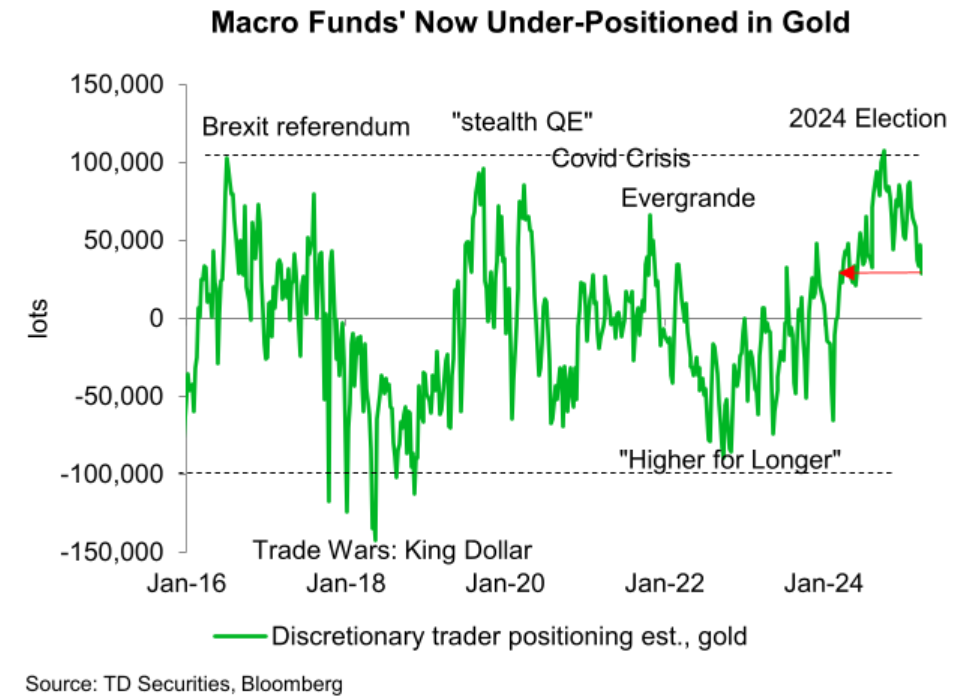
Haven: Gold prices have been in the red since the tariff announcement, although on a relative basis not down as much as stocks (down about 2%). TD is out with a note this morning that says it could be because gold was overbought at these levels. However, they note that gold is still “under-owned” by funds (see chart below.) “Overall, gold remains significantly under-owned, mitigating downside risks. Seek shelter in the yellow metal’s warm embrace,” wrote TD’s commodities team. This is a sentiment shared by Dan Dreyfus who says he sees a scenario where gold can hit $4,000/oz.
Submit your questions or email us questions@inthemoneypod.com