

“I hate this market. It’s funny because we are strongly outperforming, but I still don’t like this market.” That’s how dividend investor Rebecca Teltscher, Portfolio Manager at Newhaven Asset Management, sums up today’s market on this episode of In the Money with Amber Kanwar. Value is working. Dividend stocks are back. Utilities, pipelines and energy have seen major inflows. And yet, Rebecca says this is one of the hardest environments she’s seen to deploy capital, with sectors moving quickly from unloved to fully valued.
Another weekend where everything changed. Read about what to expect for the week ahead in my Globe and Mail column.
Here are five things to know today:
Get it strait: The fallout from the US & Israel attack on Iran has been swift in the markets
- Global equity markets are sharply lower
- US futures are indicating a 1% drop at the open
- Crude oil has popped 8% to $72/bl
- Gold has hit a fresh record at $5,400
- The US dollar rallied
- Defense stocks like Lockheed Martin (+5%), RTX (+5%), and Kratos (+6%) are all higher in the pre-market
- Airline stocks are also broadly lower on travel disruptions from the war and the spike in oil prices
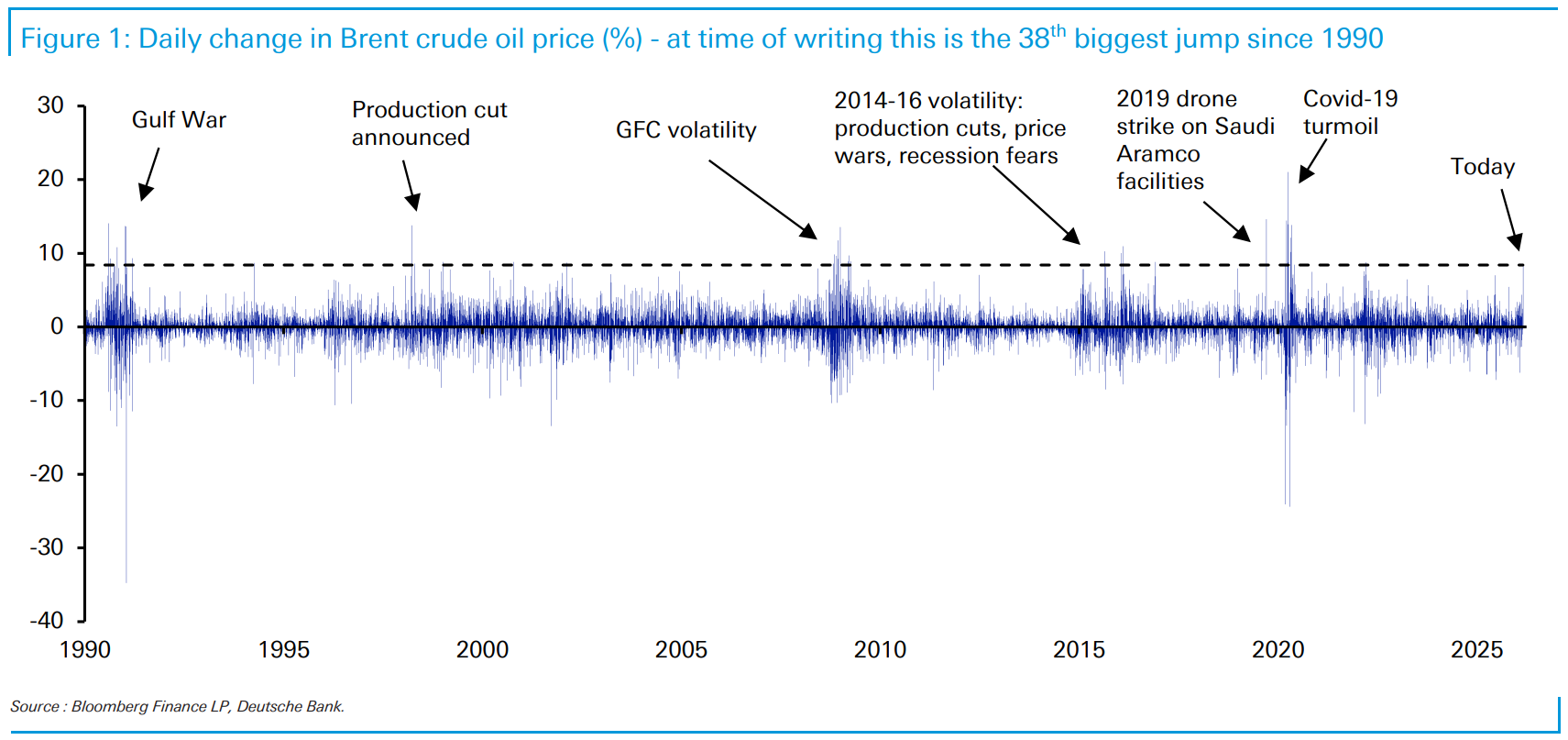
How high do oil prices go? It depends on how the Iran situation plays out and when the Straight of Hormuz – a key shipping channel – opens back up again. “The war between the U.S./Israel and Iran represents the biggest challenge for the global oil market since Iraq’s invasion of Kuwait in 1990,” wrote BMO’s energy analyst Randy Ollenberger, “Speculation that hostilities could break out have supported oil prices by US$5-8/bbl over the last several months. Actual hostilities mean higher oil prices; a spike through US$100/bbl is probable if important oil facilities are bombed.” The closure of the Straight of Hormuz presents challenges beyond crude. About 20% of global LNG goes through the Straight. Nat gas prices are spiking across major hubs. “Disruptions, if they last, could push what had been slowing global inflation the other way and delay any efforts to normalize monetary policy (depending on each central bank),” wrote BMO Economist Jennifer Lee. Below is a look at the price shock in crude. It is the 38th biggest over the last 36 years according to Jim Reid at Deutsche Bank. The fact that gold and oil are ripping could help the TSX outperform today.
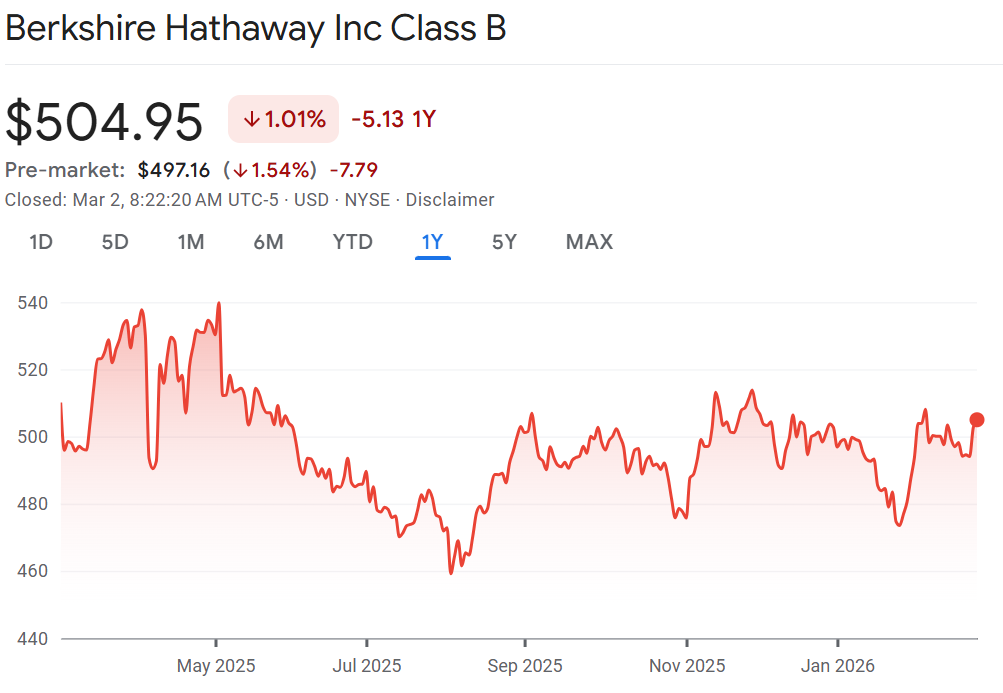
Upstaged: Getting lost in the BIG news is the fact that Berkshire Hathaway reported results for the first time without Warren Buffett as CEO. Greg Abel’s first quarterly results as CEO were less than stellar, operating income dropped nearly 30% thanks to a decline in its insurance underwriting business. Berkshire Hathaway is down about 1.3% in the pre-market. Abel also penned his first annual letter to shareholders which was mandatory reading under Buffett. In Abel’s letter he noted that Buffett “is obviously a very hard act to follow.” If his letter was meant to reassure investors that Berkshire would stay the course, it was successful. Especially on two sticking points: buybacks and dividends. Berkshire has underperformed the market and Buffett was stubborn about deploying capital through buybacks or dividends. Abel confirmed neither were likely. So what of that massive $373.3 billion cash pile? “Many times in Berkshire’s history, some observers have suggested that our substantial cash position signals a retreat from investing. It does not,” wrote Abel, “We continue to evaluate many opportunities and will remain patient and disciplined in pursuing the right ones for the benefit of our owners.”
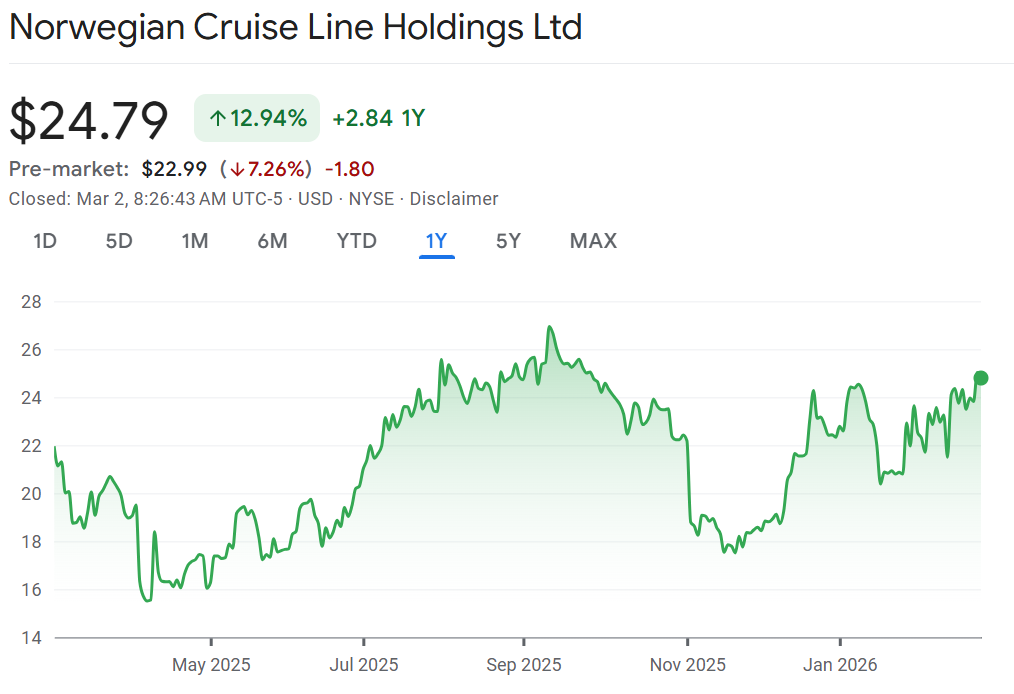
Choppy waters: Norwegian Cruise Line is down 7% on a combination of a risk-off tone from Iran and a weaker than expected forecast. The cruise liner’s profit forecast was lower than expected as advanced bookings on cruises stagnate. This comes as activist investor Elliott Investment Management has been nipping at their heels at their heels. CEO John Chidsey acknowledged there have been execution failures on the conference call with analysts this morning. Chidsey has been in the job for and immediately had to content with Elliott after it disclosed a more than 10% stake and was critical of management and spending in particular. Chidsey said the company has been in touch with Elliott and is interested in their thoughts. Norwegian is the worst performing cruise company in the US over the past two years up only 31% compared to peers which have all more than doubled over that time.
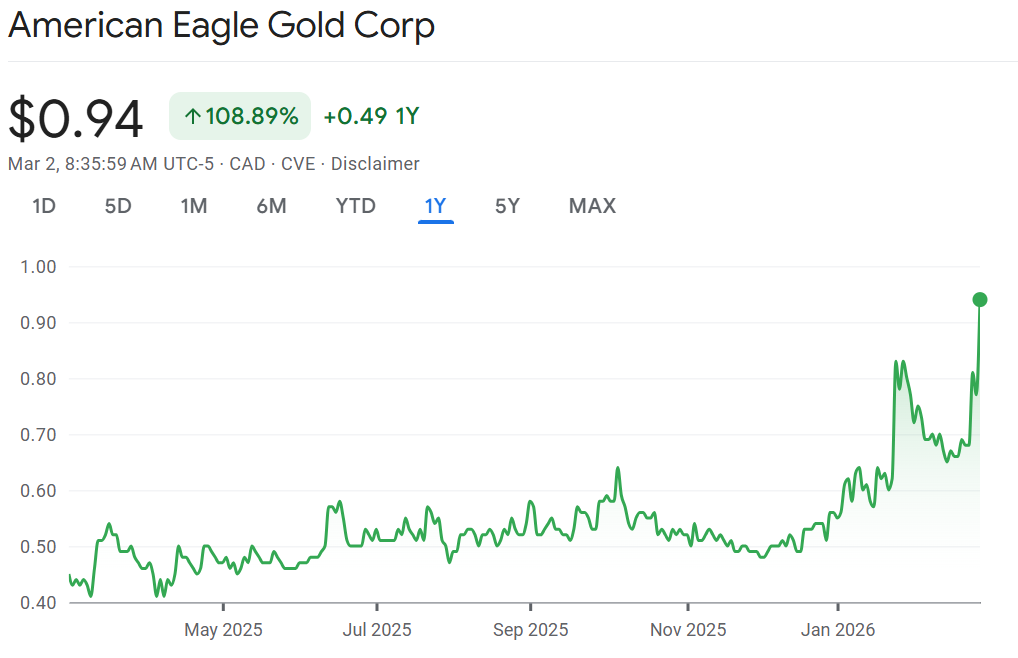
Sprott watch: Watch shares of American Eagle Gold after the junior minor announced a $23 million investment from Canadian mining billionaire Eric Sprott. Normally a company with $163 million market cap doesn’t get a mention in the newsletter, but an investment of this magnitude warrants some attention. Despite the name of the company, this is a play for copper which is a rare type of investment for Sprott. “NAK has truly caught my attention,” said Sprott in the press release referring to the gold-copper play in BC, “I believe the grade and length of the intervals are exceptional, and the gold grade is the icing on the cake.” Teck Resources is another major backer of the company.
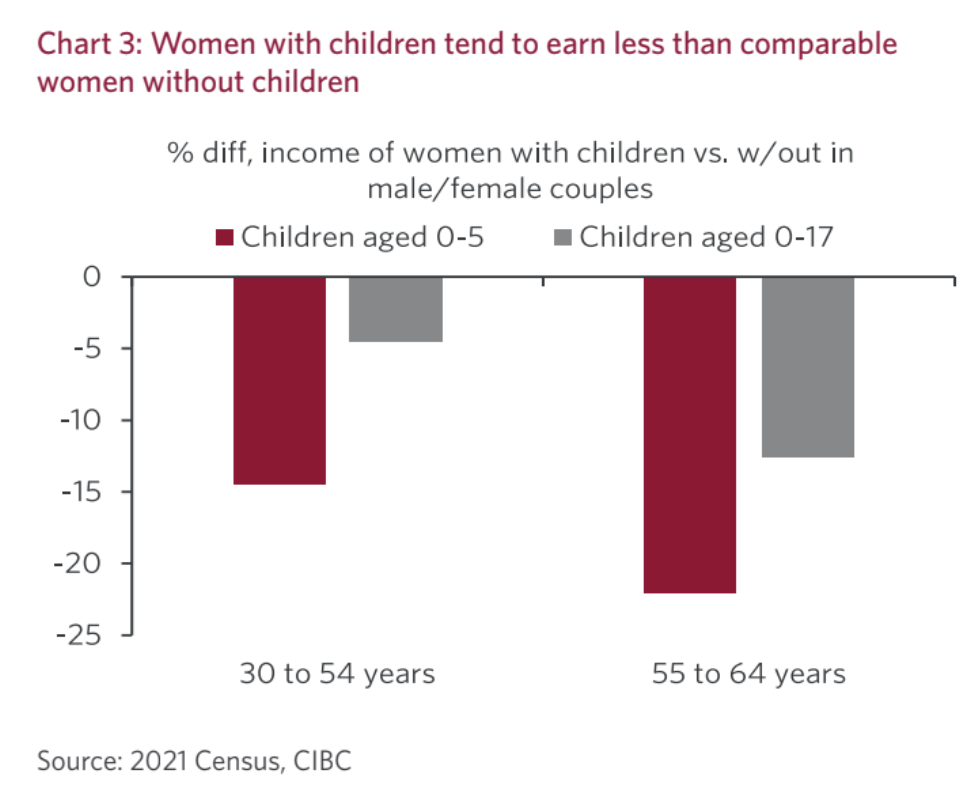
Motherhood penalty: CIBC’s economic team released a report this morning on the motherhood penalty in the workforce. To put bluntly, the data shows that women with children earn less than women without children mainly due to lack of childcare options. “Women experience a large drop in earnings upon maternity leave, and ten years after the birth of the first child, the gap is narrower but still exists.” wrote CIBC’s Katherine Judge. What happens when childcare access is expanded? Quebec provides a case study. “Quebec began expanding access to subsidized daycare in the late 90s. And the results from a (Université du Québec à Montréal research paper) show that the long-run earnings penalty for Quebec mothers were greatly reduced after those policies were implemented.” If you read this and are a position of power or policy, take note. “Raising children takes time, and that investment has its rewards. But allocating that time more equally within male/female couples, and making childcare more cost effective, can help reduce the degree to which parenthood cuts into economic activity and women’s career progress,” concluded Judge.
Don’t miss our next guest!