
Canada vs. The World: Where should investors put their money now? Canadian stocks have outperformed the U.S. over the past year, but after a powerful rally in banks, energy and materials, is there still room to run? Or are the better opportunities now overseas? With valuations climbing, bond yields rising and investors questioning the dominance of U.S. equities, the global investment landscape is shifting. In this special episode of In the Money with Amber Kanwar, recorded in Vancouver, we’re staging the great investment showdown with Kevin McSweeney and Matthew Strauss, Co-Heads of Equities at CI Global Asset Management. Kevin makes the case for Canada as a potential turnaround story, while Matthew takes us around the world to uncover opportunities in Europe, Asia and emerging markets.

Looking to invest in high-quality companies without high fees? The HAMILTON CHAMPIONS™ suite of ETFs offers exposure to diversified portfolios of equity champions across tech, financials, utilities, and dividend strategies, all with a low 0.19% management fee, designed to help you stay invested with confidence for the long term. For more information on the HAMILTON CHAMPIONS™ suite, visit: www.hamiltonetfs.com/hamilton-
Here are five things to know today
1.
Stocks mixed, big catalyst day, oil higher
Nasdaq futures are higher while the TSX and Dow are indicated lower ahead of a catalyst rich day that includes both the Bank of Canada and Federal Reserve rate decisions punctuated with megacap earnings from Microsoft and Alphabet after the close. The Bank of Canada is expected to increase rates despite tepid economic growth after BOC Governor Tiff Macklem hinted he is concerned about inflation reaccelerating. In addition to the rate decision we will also get the Monetary Policy Report. Meanwhile, the Federal Reserve is expected to keep rates unchanged but given Chair Kevin Warsh is loathe to provide forward indications of the rate path it is fair to say that expectation is tinged with anxiety. What is clear is that the US is also experiencing reaccelerating inflation and the market is pricing in two more rate hikes in the next six months. In a world full of surprises, I wouldn’t be surprised if it’s the Bank of Canada that holds and the Federal Reserve hikes. Although that scenario would hit the Canadian dollar, so the desire to keep rate differentials narrow between the two countries could end up being the driving force for the BOC.
Microsoft and Alphabet will provide the post-trading day fireworks when they report earnings. Microsoft has massively outperformed Alphabet since the last earnings season – up 35% over the past three months compared to Alphabet which is down 3%. The reason is because Microsoft is still generating free cashflow (albeit lower than before, but not negative like Alphabet), Microsoft has been cutting costs to offset spending on AI, and it hasn’t had to raise money through equity like Alphabet did. As a result, expectations are high for Microsoft going into the quarter: the cloud business is expected to grow 45% this quarter – a high bar to be sure.
Then there is energy, the inflationary elephant in the room. Crude is back up today, trading over $100/bl on reports in the Wall Street Journal that the Trump administration is warning Gulf states to prepare for new operations against Iran after the midterms. Suggesting a higher for longer energy environment.

2.
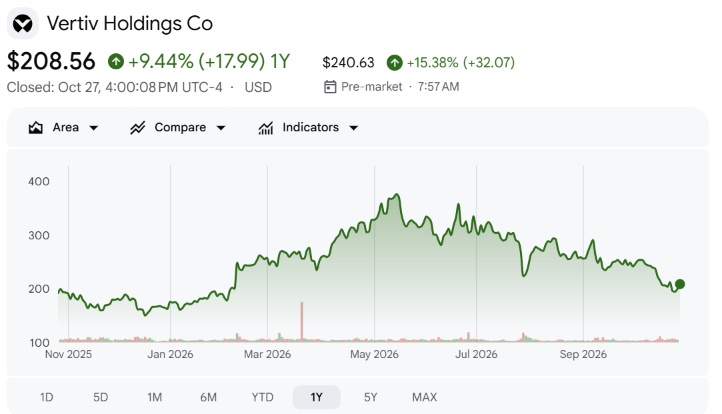
Vertiv +15% pre-market on blowout results
The power equipment and data centre cooling company reported sales and profit that trounced expectations and sales this year will be triple last year. The results are providing relief to the stock which is down 45% since its peak in May. Concerns about AI spending coupled with supply chain and execution issues hurt the stock. Much of the growth this quarter was organic, which was a key point for investors. “We think the revenue and margin outperformance gives management credibility that the June shortfall was timing-related rather than a demand issue,” wrote Evercore’s Amit Daryanani. He’s got a buy rating and $325/share price target.
GE Vernova also reported and beat expectations, but the stock is up a meagre 1% in the pre-market. The utility and energy infrastructure company is benefitting from AI as well with high power grid equipment demand powering a 27% increase in total sales. It also increase its full year sales and free cash flow forecast. While investors ignore the results, the fundamentals show AI spending is intact with the backlog ballooning to $197 billion.
3.
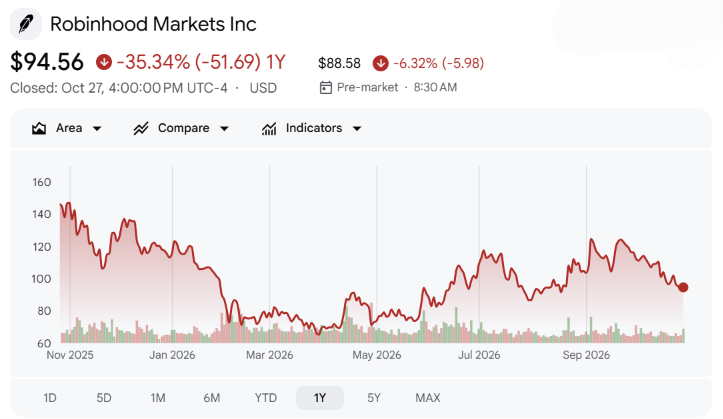
Robinhood drops 6% pre-market, Wealthsimple gets new funding
Shares of Robinhood are dropping after profit missed expectations and sales were weaker than expected on lower customer engagement. The trading platform had weaker transaction based and interest based revenue than expected as well as lower equity activity than analysts were expecting. Morgan Stanley says the results need to be put in context. “October volumes in equities, options and crypto are each within ~5% of record 3Q levels, and event contracts are running ~10% higher,” wrote Morgan Stanley’s Michael Cyprys. He isn’t fussed about engagement either. “Investor concern that weakness in AI / semiconductor stocks would pull down retail engagement has not been borne out so far. Mgmt said HOOD’s younger, tech-forward customers tend to buy into selloffs, and down days are often among the strongest for net buying.” The buy the dip generation. New products are key to the stock, says Cyprys, who notes that prediction markets continue to broaden their product offering making up 30% of trading volume this quarter. I own Robinhood.
Watch Power Corp after announcing it will participate in a new funding round for Wealthsimple valuing it at $13.8 billion – which is 38% higher than its last equity raise in October 2025. Wealthsimple is raising $425 million and the Desmarais-backed IGM and Power Corp will take up $164 million of that. This way, they maintain their large ownership stakes in a trading platform that is poised to boom according to TD’s Graham Ryding. “Based on what we view as conservative growth rates (15% – 30% assets under administration growth) and consistent valuation ranges (7-9% of assets under administration), we see potential for the Wealthsimple valuation to increase to $20bln – $46bln by 2030.” Wealthsimple is a sponsor of In the Money with Amber Kanwar.
4.
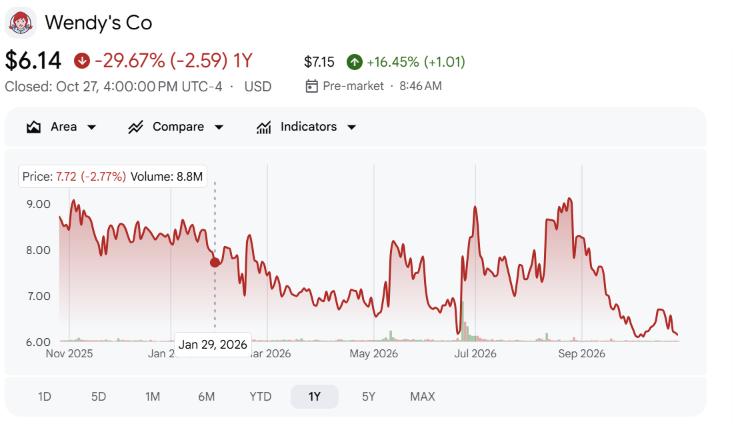
Wendy’s surging 16% on takeout offer
Billionaire Nelson Peltz of Trian Funds is offering to buy Wendy’s for $7.35/share in a low ball offer. Wendy’s traded higher than that just a few months ago. Peltz, known for his activism and opportunistic investing style, already owns about 16% of the company. So at the very least, his offer could put a floor under the stock. Speculation about a bid has been around for a while and actually the stock sold off in the summer because of reports that Peltz wasn’t going to make an offer. Whatever happens, I hope they don’t change the spicy chicken. It was a such a dietary staple of mine back in university that my grandfather used to call me Wendy.
5.
Scotia upgrades Sun Life, downgrades Manulife
Scotia’s Mike Rizvanovic says headwinds in Sun Life’s US segment are fully priced in while Manulife’s asset management and alternative investments could become headwinds. While both stocks have done well, Sun Life shares have underperformed Manulife over the past year. Rizvanovic says a combination of well understood US headwinds, better growth from its asset management business, and better relative valuation make it the better buy here. Manulife, by contrast, has seen net outflows in recent quarters. Its alternative long duration asset business has been a disappointment, underperforming expectations for 16 straight quarters. Manulife may cut the return expectation from this business which could become a headwind to earnings. “We believe there is a risk that MFC will need to walk back its ROE target of 18% plus for 2027,” writes Rizvanovic. In contrast, he believes Sun Life can hit their 20% ROE target.
Don’t miss the next episode!