This week on In the Money with Amber Kanwar, Canoe Financial’s David Szybunka makes a bold call: we’re only in year 5 of a 15-year bull market for energy. David explains why the last three years were just a “digestive phase,” why energy stocks are quietly outperforming even with $60 oil, and why he sees the cycle shifting from disbelief to the early stages of optimism. He breaks down the flows, the fundamentals, and the global capital piling back into Canadian energy—from private equity to pension funds to supermajors—regardless of the prevailing political narrative.
Pro Picks is brought to you by ATB Financial. With $62 billion in assets, ATB Financial is powering possibilities for more than 820,000 financial services clients in Alberta and beyond. ATB’s Capital Markets arm is a full-service investment dealer that offers investment and corporate banking, sales and trading, institutional research, and risk management. Visit www.ATB.com/inthemoney for more information.
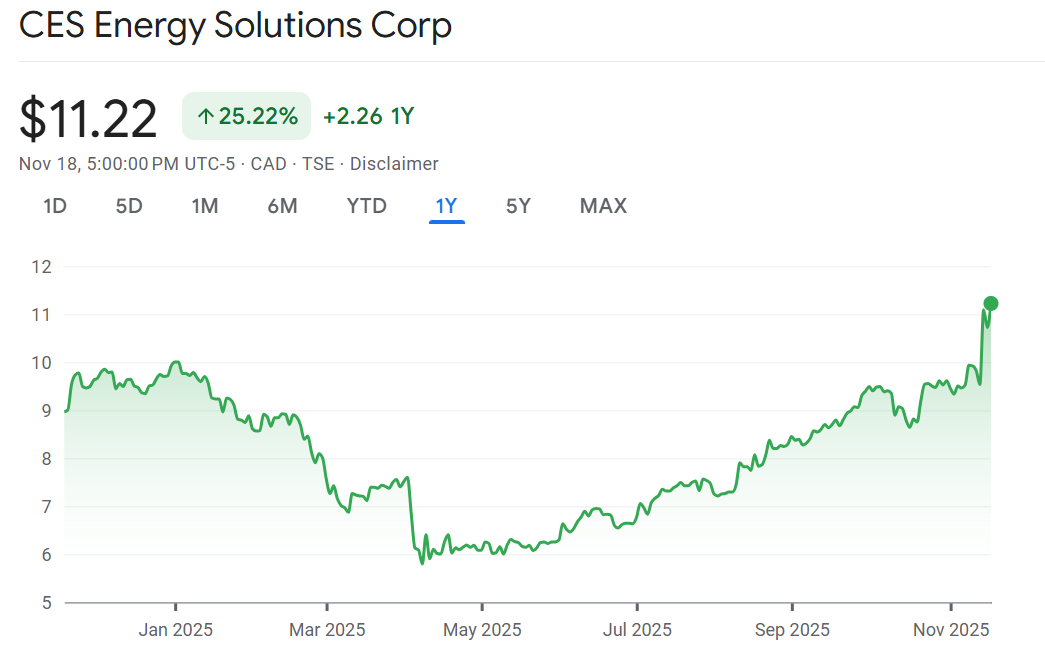
CES Energy Solutions (CEU:TSX)
Thesis: Capital-light energy services compounder that’s still priced like a cyclical afterthought.
- Mispriced vs. history: CES is a capital-light production chemicals & drilling fluids business that used to trade around ~13x EBITDA in prior cycles; today it’s closer to 5.5–6x, despite being a better, more resilient company now.
- Share gains in a weak rig market: U.S. oil rig count is down >10% year-over-year, yet CES just printed essentially flat EBITDA vs. last year, reflecting strong U.S. market share gains, longer laterals, and more frac-intensive wells supporting volumes and margins.
- Upside without higher oil: Management just won a major offshore contract that likely pulls through more work (including onshore Permian), and if you simply put an 8x multiple on their 2027 forecast numbers you get to roughly a $17 share price — without needing higher commodity prices for that rerating.
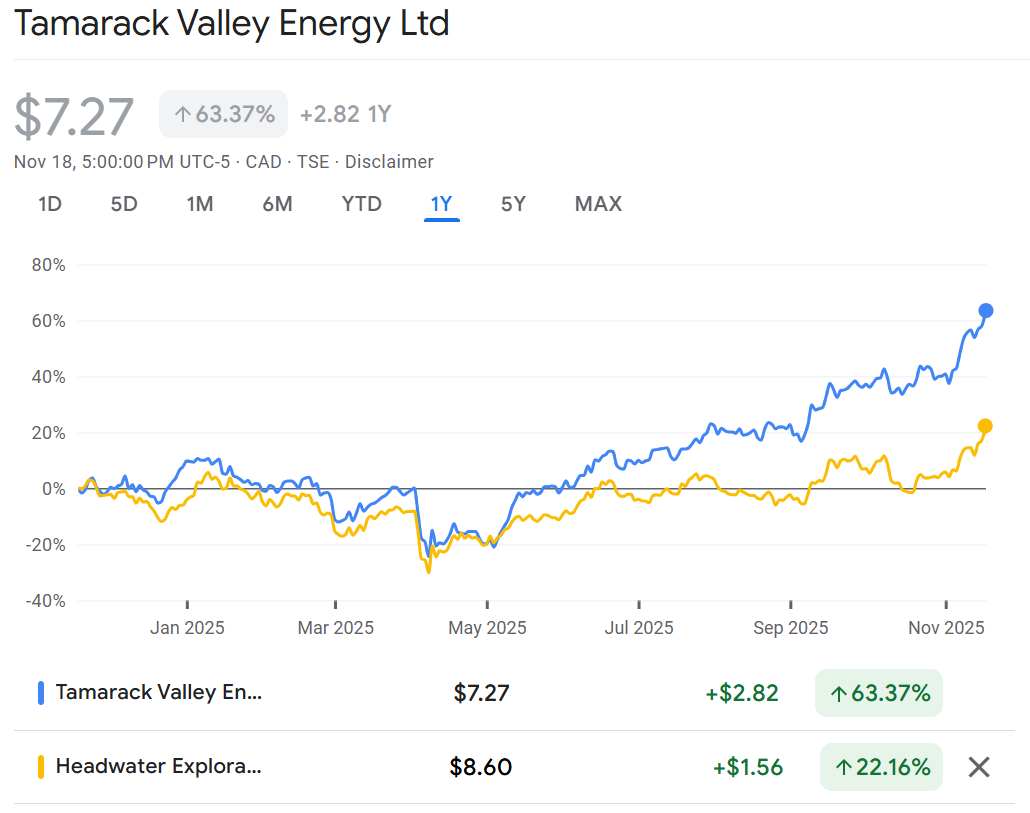
Clearwater Oil – Tamarack Valley Energy (TVE:TSX) & Headwater Exploration (HWX:TSX)
Thesis: Clearwater is “the best oil play” he’s seen in his career – own both key operators.
- Best-in-class economics: Clearwater is a heavy oil play that uses simple multi-leg (not frac-intensive) wells with very fast payouts: you typically recover your drilling cost in 7–8 months and then get multiple additional payouts over the life of the well, unlike many shale plays that rarely see a true “second payout.”
- Waterflood unlocks even more value: Recent water-injection programs are expected to boost recovery factors from ~5–7% up to ~20–30%, lowering decline rates and sustaining capital while freeing up more cash for dividends, buybacks, further waterfloods, and new wells — powerful built-in tailwinds for both Tamarack and Headwater.
- Own both camps: Tamarack cemented decades of inventory with the DeltaStream deal, while Headwater’s Pelican discovery has been producing ~500 bbl/d with a 3–4 month payout and plans for a polymer flood; together they’re set to generate enormous free cash over five years, with Headwater’s forecast free cash approaching ~60% of its enterprise value and Tamarack’s ~50%, roughly double their peer group.
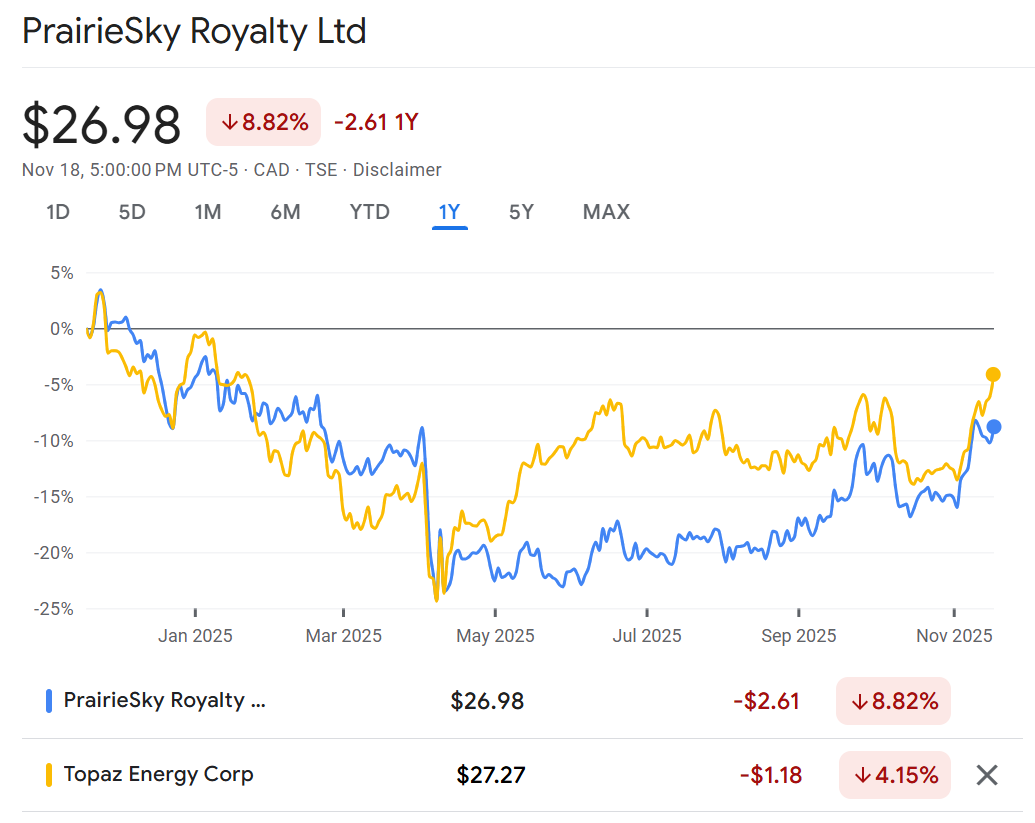
Royalty Barbell – PrairieSky Royalty (PSK:TSX) & Topaz Energy (TPZ:TSX)
Thesis: Royalty companies are quietly as cheap as producers, even though they’re structurally better businesses.
- Same yields, less risk: PrairieSky and Topaz currently trade at free cash flow yields similar to E&Ps, which “makes absolutely no sense” given their royalty model — they clip top-line economic rents without capital intensity, making them more like exchanges or metal royalty companies that compound value over decades.
- Mispriced vs. metal royalties: Precious metals royalty names like Franco-Nevada often trade at 25x cash flow at high gold prices, while oil & gas royalty names trade closer to 13–16x at much lower implied oil assumptions ($60). The setup is that you’re paying a “cheap producer” multiple for “great royalty” economics.
- Core, compounding ballast: As mid-cap producers have run (e.g., some names up ~30% in a month), he’s been rotating weight into these royalty names that “haven’t moved,” using them as a portfolio barbell to protect downside while still capturing upside from a rerating back toward the premium multiples they enjoyed at IPO.
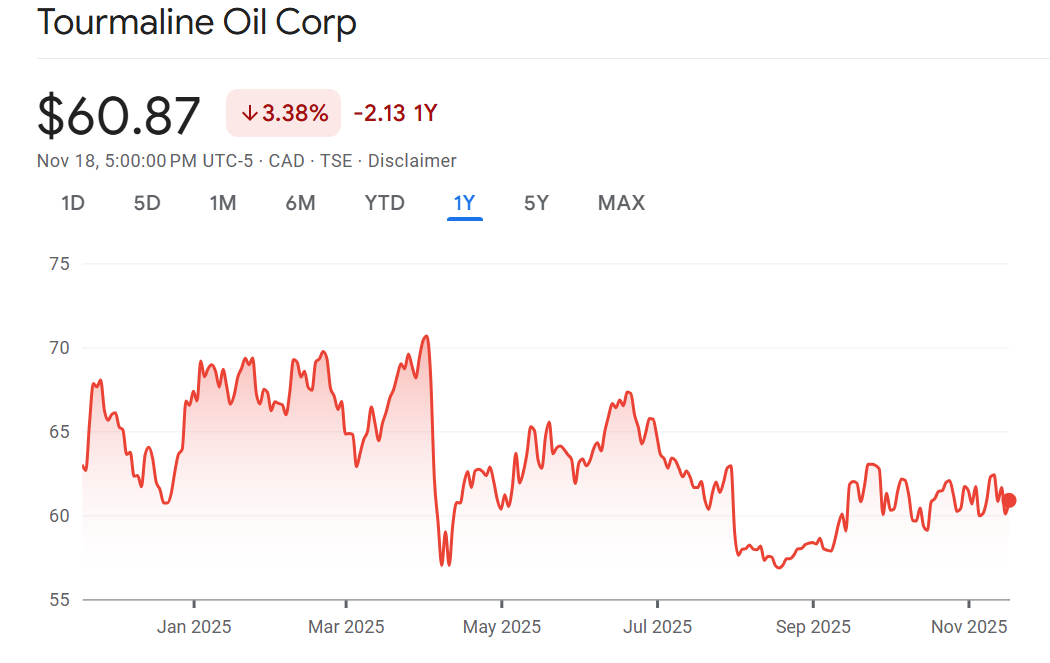
Tourmaline Oil (TOU:TSX)
Thesis: The smartest long-duration gas aggregator in the basin, building for a 50-year LNG and data-center world.
- Structural gas demand story: Global gas demand is growing at roughly 2x the pace of electricity and ~3x GDP, driven by LNG and, increasingly, data center loads; yet investors still insist gas companies never grow, a disconnect he sees resolving in favor of scale resource owners.
- Mike Rose is not dumb – he’s early: While the market frets about fewer special dividends and more capex, Tourmaline has “mowed down” and consolidated massive resource in northeast B.C. via deals like Saguaro, Todd, and Strathcona assets, ending up with ~75 years of inventory. Mike Rose looks like he’s fighting the tape today, but he’s actually positioning the company where the puck is going.
- Optionality to big buyers: As LNG build-out and data-center demand ramp over the next 12–24 months and beyond, large players will need secure, long-life gas. The moment those contracts and partnerships crystallize, he expects investor focus to flip from near-term free cash flow yield to “who controls the most high-quality resource,” a lens under which Tourmaline should command a much higher valuation — the playbook is to get long, park capital, and “wake up rich” over a multi-year horizon.
Don’t miss our next episode!

DISCLAIMERS: The information provided in this podcast is for informational purposes only and does not constitute financial, investment, or professional advice. The views expressed by the host and guests are their own and do not necessarily reflect the opinions of any organization or company. The host and guests may maintain positions in any securities discussed on the podcast. Always consult with a qualified financial advisor or professional before making any investment decisions.