How tariffs are roiling the markets this morning
I know it is my job to tell you what is going on in the market, but the last 24 hours I’ve had an assist from my husband who has been shouting out pre-market quotes from the other room since the futures opened last night. Some prefer acts of service as their love language, ours is quoting tickers.
The tariffs: President Trump signed an executive order imposing a 25% tariff on imports from Canada and a 10% tariff on energy imports staring February 4th. Trump also levied 10% tariff on all imports from China. Ostensibly this was because of the “influx of illegal aliens and illicit drugs.” Canada announced 25% retaliatory tariffs on $155 billion worth of imports from the US, $30 billion of which are effective tomorrow while the remainder will come in after a 21-day consultation period. That’s where things stand right now. The US could retaliate with more tariffs. Trump and Prime Minister Trudeau are expected to speak today which could risk escalation or make this entire day moot if they are somehow able to come to a resolution.
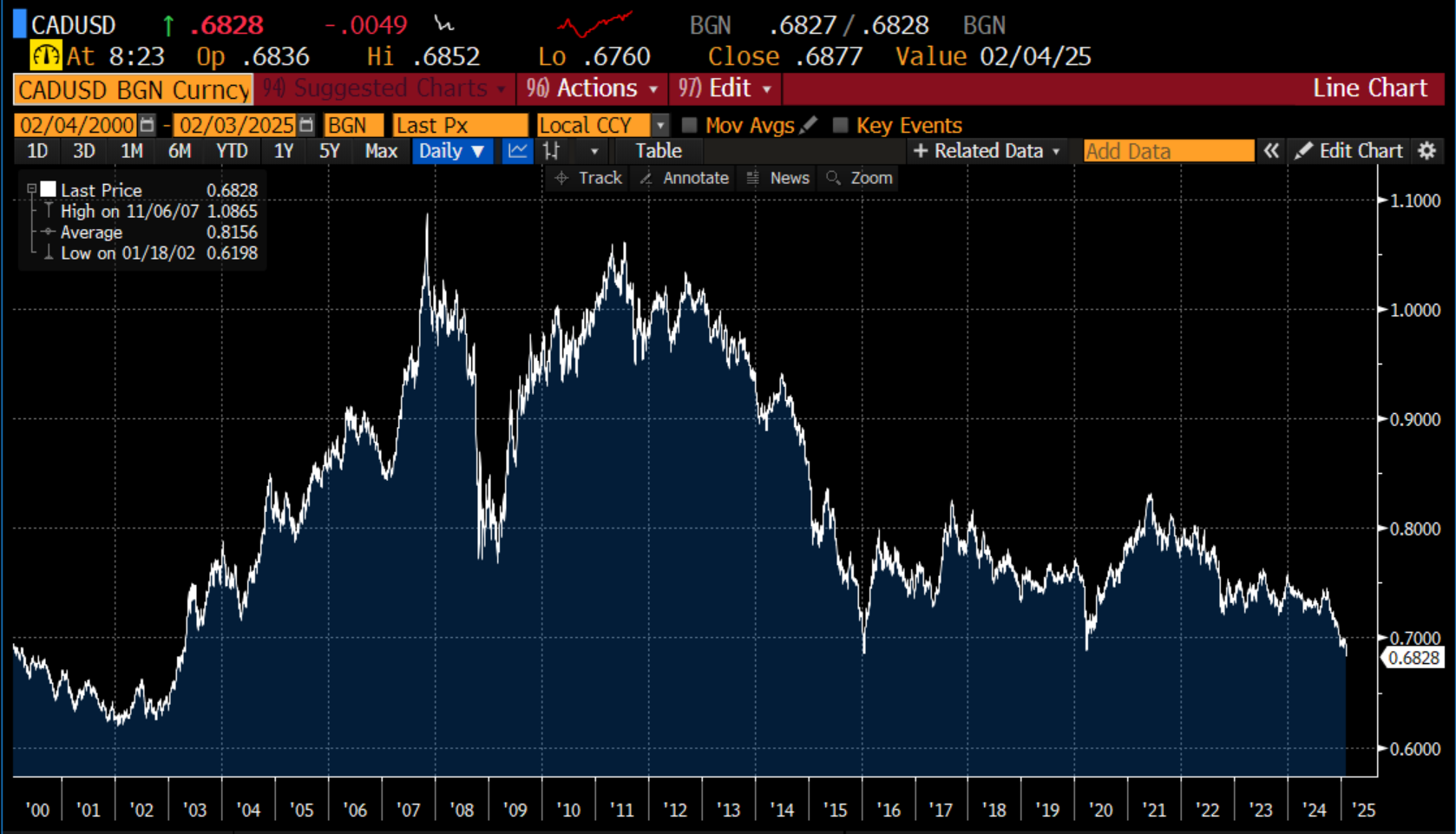
The reaction: The Canadian dollar plunged to the lowest level since 2003, futures are down 1.5%, European markets are a sea of red as Trump warned Europe was next on his tariff hit list, and crypto sank. Goldman Sachs is warning the S&P 500 could fall 5% over the coming months as a result of tariffs. Scotia wrote that the TSX is in for a rough patch, noting that it closed just 1% from an all-time high and perhaps Bay Street investors have been too complacent in the face of imminent tariff threats. “To provide some perspective, a one point drop in the TSX fwd P/E ratio to 14.5x and assuming no/zero EPS growth in 2025 (2024 EPS of C$1475) would imply a 15% decline from current levels (that’s not our call for now, but the longer it lasts, the bigger the impact),” wrote Hugo Ste-Marie at Scotia. As for the economy, BMO’s Chief Economist Douglas Porter now sees the Bank of Canada cutting interest rates at every meeting until October with rates settling at 1.5% (from 3% currently), the economy flatlining in 2025 and unemployment going up to 8% (from 6.7% currently). What this means for inflation is a little less certain in Canada because higher prices may be offset by lower demand stemming from unemployment and weak economic activity, wrote Porter.
Sectors to watch: The pre-market losses are dominated by stocks in sectors that are the most vulnerable to a trade war.
Autos: Car makers and car-part makers are all down in the pre-market. Shares of General Motors (-8%), Ford (-5%) are sharply lower while Magna (-6%) is also struggling. Shares of Tesla are also down (-3%) but not as much as other auto stocks.
Semiconductors: The semiconductor sector is down 3% in the pre-market with Nvidia down 4% on tariff concerns.
Miners: Base metal companies are under pressure as the prospect for economic growth stalls. Copper is modestly lower while base metal equities like Teck Resources (-3%), BHP (-1%), and RioTinto (-1%) struggle.
Financials: The bank stocks on both sides of the border are all down in the pre-market. “Although Canadian banks have no direct exposure to tariffs, it goes without saying that their fortunes are intimately tied to the health of the Canadian economy,” wrote Meny Grauman of Scotia. He warns that Canadian bank stocks are especially vulnerable because they came into this crisis with “very rich” valuations.
China: While Chinese markets held in relatively well overnight, the Chinese tech companies listed in New York are under pressure. Alibaba (-3%), JD.com (-5%), and Baidu (-4%) are all down.
This is by no means an exhaustive list. Industrial sector will also feel the pinch with rail stocks being downgraded at Loop Capital (CN Rail and CP Rail both cut to sell). Alcohol companies are down sharply (Constellation Brands -6%).
Energy stocks: The price of oil is actually up as the prospect of supply disruption overshadows concerns about reduced demand. For Canadian energy stocks this means that the discount on Canadian oil prices will widen further, says Eric Nuttall of Ninepoint Energy in a post on X. However, he says that a weaker Canadian dollar could “blunt” the impact (because producers receive revenue in US dollars). He suggests that Canadian energy stocks could already be discounting this outcome and not be under huge pressure today. RBC is saying something similar in a note to clients this morning. “(Tariffs) were far less than feared but could be fluid and will serve to disrupt North American energy flows and security,” wrote the energy team at RBC, “That said, the widening of WCS-WTI spreads to $16.25 late on January 31 already appears to have discounted such an outcome.” In terms of what this means for stocks, they say there are no winners only relative losers. “Integrated oil companies like Suncor Energy (about 40% of its crude oil exported to the US) and Imperial Oil are partially insulated via their retail distribution networks in Canada. BP would be the most exposed from the global majors given its PADD II refining exposure,” they wrote.
What’s up?: The US dollar is advancing against its global trade partners and the price of gold is a little higher. Gold prices are inching toward a new all-time high this morning with a gain of just 0.5%. Bonds are rallying benefitting from a safe haven play and perhaps the prospect of more rate cuts. Where else can you hide? Scotia says insurance stocks provide safe haven. “…We believe that the group also stands out as a safe haven from the recently launched Canada/US trade war,” wrote Grauman in a note to clients this morning. The team is upgrading Great West Life as their top pick followed by Manulife. “Over the last month the lifeco group has lagged the TSX even in the face of tariff talk, and despite the fact that long yields continue to move higher in the US while North American equity markets continue to perform very well. Put it all together, and we like the set up for year-end lifeco reporting both in terms of quarterly fundamentals themselves, but also because of the ability of these stocks to provide shelter from the coming tariff storm,” wrote Grauman.